
Judges' AI Rules Differ by State: What Firms Should Check
A 50-state survey published November 5, 2026 finds no national rule for judges' AI use. Here is what law firms should check before filing.
Quick answer
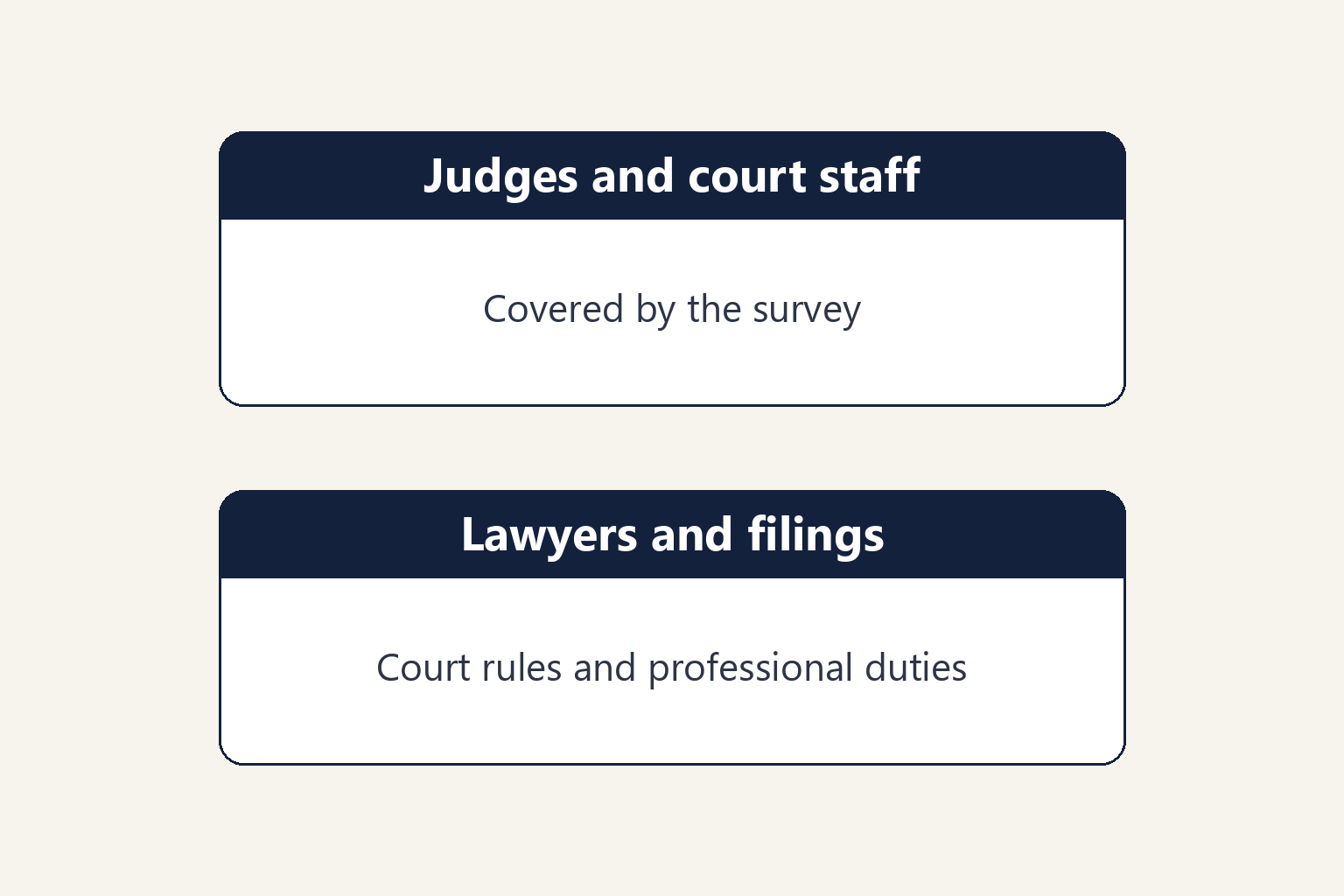
No national rule governs how judges use AI. A 50-state survey published November 5, 2026 found policies that range from detailed rules to no statewide policy at all. The survey covers judges and court staff, not lawyers. Firms still need to check the rules of each court where they file.
What the survey found
Bob Ambrogi published the survey on LawNext on November 5, 2026. It reports the status of each state's policy as of October 30, 2026. It covers judges, magistrates, law clerks, and court administrators. It does not cover policies aimed solely at attorneys or litigants.
The survey does not publish totals. Our count of its status labels gives this picture:
- 18 states had a policy in effect.
- 1 state, Iowa, adopted a policy that takes effect January 1, 2027.
- 3 states had internal or administrative controls only: Indiana, Kentucky, and Maryland.
- 12 states had principles, guidance, or recommendations.
- 2 states were still developing a policy: Colorado and Kansas.
- 1 state, Wisconsin, saw its proposed rule dismissed on October 15, 2026.
- 13 states had no statewide policy the survey could identify. North Carolina is in this group, with local orders only.
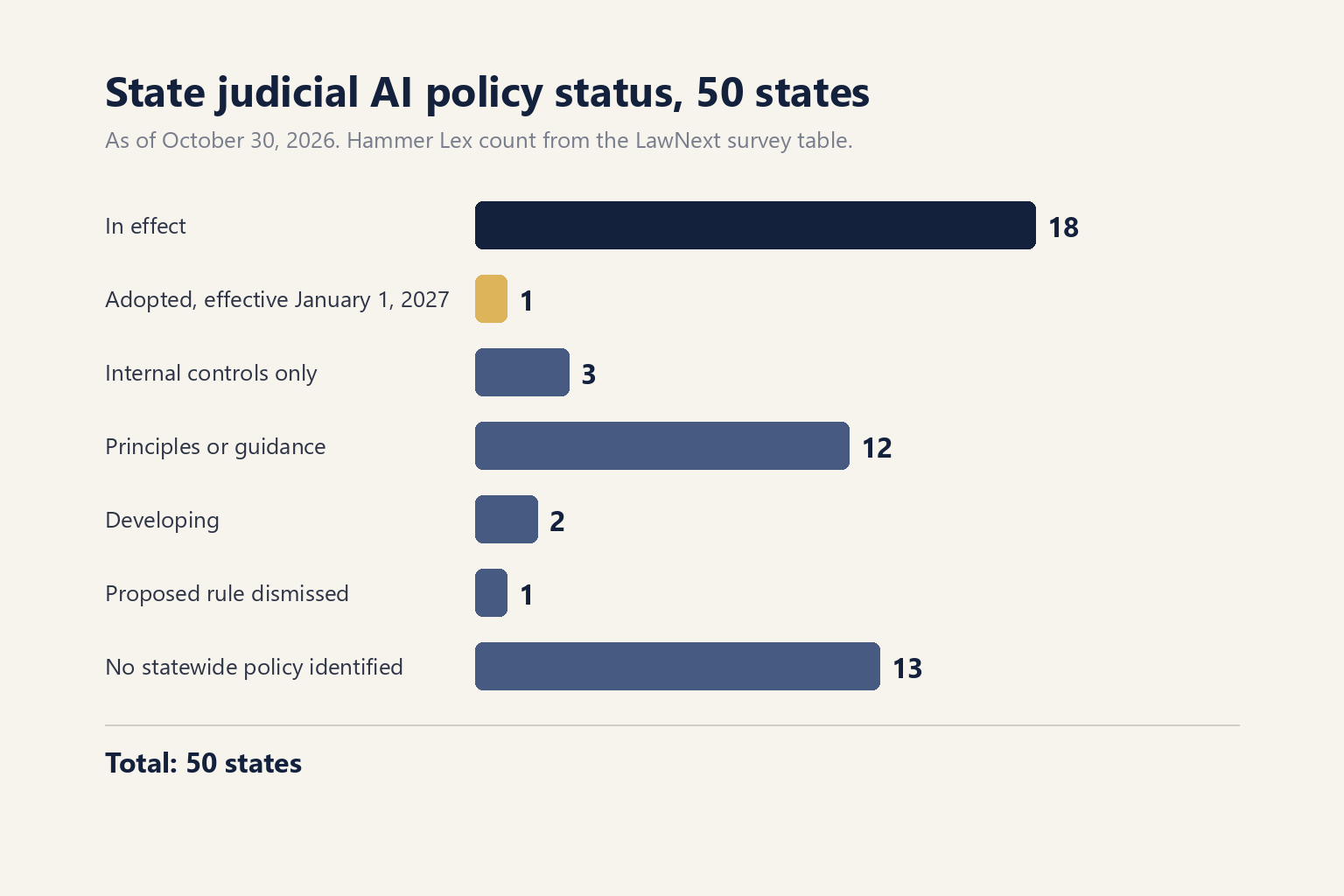
*Chart. Hammer Lex count of the status labels in the LawNext survey table, as of October 30, 2026.*
The author cautions that "not identified" does not necessarily mean no policy exists. Read the 13 as "none found." Some of them may have a policy the survey did not locate.
The survey also reports common ground. Its author says the policies agree on one point: judges cannot delegate their judgment to AI. Verification of citations and facts comes up often. Some states, including Arizona, New York, Pennsylvania, South Carolina, Utah, and Virginia, control which tools court personnel may use. Policies commonly bar staff from entering nonpublic case information into a public chatbot.
Massachusetts: the most restrictive example
The survey calls Massachusetts the most restrictive state. We read the state's interim guidelines directly on mass.gov. They are dated November 12, 2025. They apply to judges, clerks, registers, recorders, employees, law clerks, interns, and contractors of the Massachusetts state courts.
The guidelines answer one question plainly. Can court personnel use generative AI for legal research, legal writing, or other legal work? The answer is "Not at this time." Court personnel may use generative AI for administrative tasks only. Only public information may go into those tools. The guidelines name ChatGPT, Google Gemini, and Microsoft Copilot as approved for administrative tasks, with the opt-out settings turned on. The guidelines also say they "will be refined and modified."
Our reading: under these guidelines, legal research in Massachusetts state chambers happens without generative AI for now. The citation check on your own filing carries more weight as a result.
What it means for your filings
These policies do not set your duties as a lawyer. Your duties come from your state's rules of professional conduct, the court's rules, and each judge's standing orders and practices. The survey does not cover those sources, so it cannot tell you what a particular court expects from your filing.
Two points follow from the survey.
First, a court's policy limits how judges and staff work. It does not regulate what lawyers do. The Massachusetts guidelines, for example, govern court personnel. Your obligations as counsel come from other sources.
Second, vendors that serve both sides create a question. On September 30, 2026, Clio announced that it had acquired Learned Hand. LawNext reported that Learned Hand "has built an AI workspace for judges and clerks that connects with court case management systems." Clio did not disclose the terms of the deal. It said it would keep supporting Learned Hand's existing deployments and pilots. The LawNext report also quotes Pablo Arredondo on combining Clio's legal information with court data. The report does not describe any separation between the two.
Hypothetical example, not a real firm: A small firm uses one research tool for client matters. The vendor later launches a product for courts. Before renewal, the firm asks for written terms on how matter data and court-side data are kept apart.
Practical checks
- Find the current judicial AI policy for each court where you appear. Use the state judiciary's website. The survey shows status as of October 30, 2026, so confirm it has not changed.
- Read each court's standing orders and local rules for AI disclosure or certification. The survey does not cover them. For New York matters, the New York State Bar's AI guidelines cover billing, disclosure, and filing checks.
- Record the policy date and scope in your firm's court-rules file. Interim policies change.
- Ask each legal AI vendor whether it also sells to courts. Ask how it separates firm data from court-side products. Get the answer in writing.
- Add a public-information test to your firm's AI policy. Massachusetts limits court staff's administrative use to public information. Apply the same classification test before client material goes into any tool. This is our analogy. The Massachusetts guidelines do not bind firms.
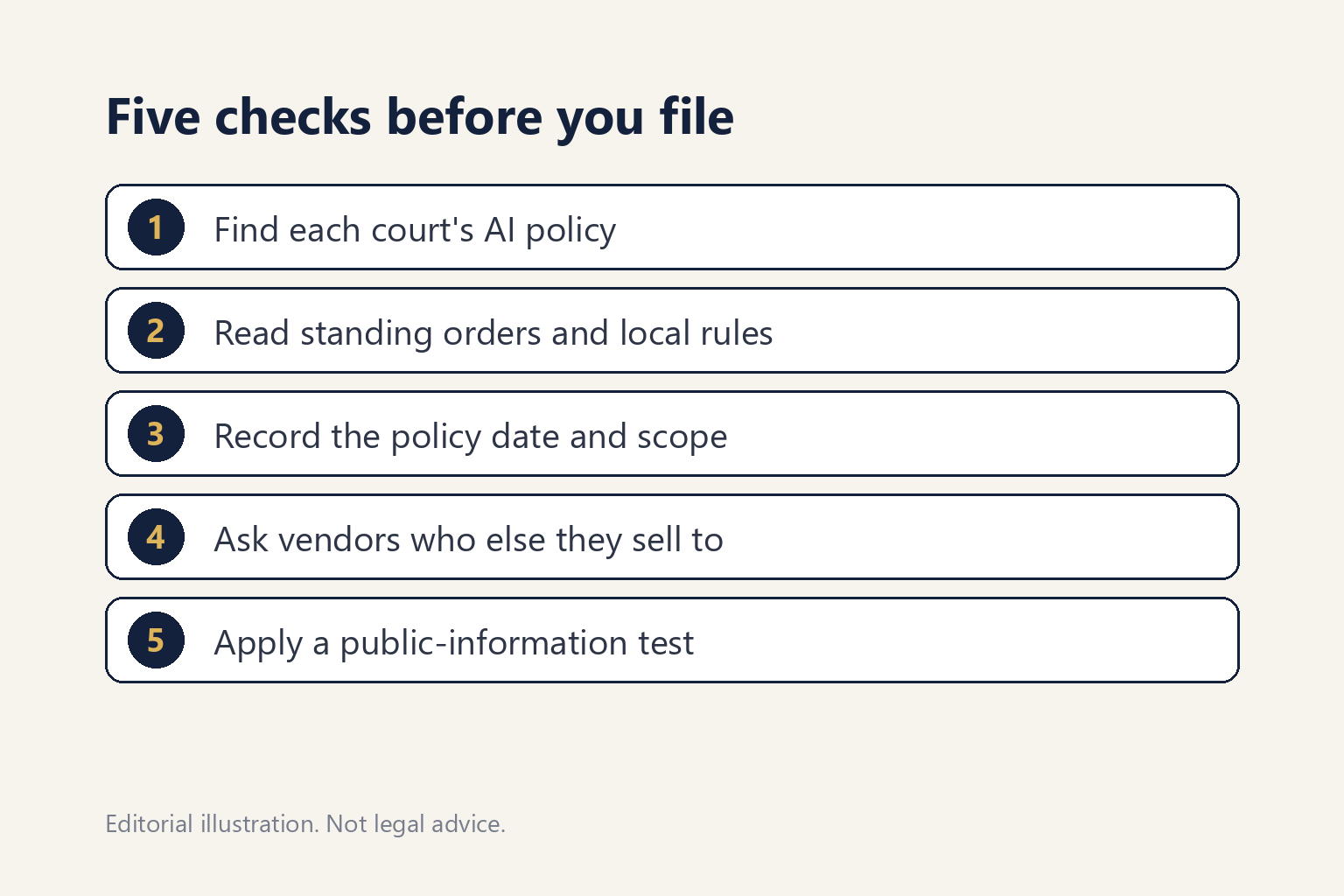
*Editorial illustration. Not a product screenshot.*
Limitations and what to monitor
- The survey author used ChatGPT to research and compile the table, then Claude to check it, and added his own research. The survey is not an official compilation.
- Our counts come from the table's status labels. We did not verify the policy text of every state.
- We read the Massachusetts guidelines directly. We could not open New York's interim policy text, so this article describes New York only as the survey does.
- Watch for Massachusetts revisions, the Iowa rule effective January 1, 2027, the Colorado and Kansas efforts the survey lists as developing, and Clio's promised judiciary product announcements.
Frequently asked questions
Do judges' AI policies apply to lawyers?
No. The survey covers judges, magistrates, law clerks, and court administrators. It leaves out policies aimed solely at lawyers and litigants. Lawyers still follow their own professional rules and each court's orders.
Can a Massachusetts judge use AI on my brief?
Judges and court staff may not use generative AI for legal research or writing at this time. The interim guidelines cover Massachusetts state courts only. They do not reach the federal courts in the state, including the District of Massachusetts. Do not assume chambers used AI to check your citations. Verify them yourself.
Does the survey list every AI order that applies to filings?
No. The survey lists state policies and some local orders. North Carolina, for example, has local orders only. Check the standing orders of the court where you file.
Is the survey an official source?
No. Use it to find each state's primary policy. Then read that policy and check its date.
Sources and scope
This article relies on three sources. The LawNext survey, published November 5, 2026, reports policy status as of October 30, 2026. We checked the author's method and scope statements against the article text on November 16, 2026. The Massachusetts Supreme Judicial Court's interim guidelines, dated November 12, 2025, were read directly on mass.gov on November 16, 2026. LawNext's report of September 30, 2026 covers Clio's acquisition of Learned Hand.
The article covers state court policies only. It does not cover federal courts, lawyer-facing rules, or local orders outside the survey. The counts are Hammer Lex's reading of the survey's table, not figures published by the survey. This article is informational and not legal advice. Check the rules that apply to your matters before you change practice.
Sources
- https://www.lawnext.com/2026/11/clio-wants-to-bring-ai-to-the-judiciary-but-50-state-survey-reveals-policies-differ-in-whether-they-allow-it.html
- https://www.mass.gov/guidance/interim-guidelines-for-use-of-generative-ai
- https://www.lawnext.com/2026/09/clio-acquires-learned-hand-giving-its-new-judiciary-business-an-existing-product.html
Keep matter records in one place
See how Hammer Lex connects matters, documents, time, and client communication in one operational view.
Book a demo