
New York Bar AI Guidelines: Billing, Disclosure, and Verification
The New York State Bar Association approved AI ethics guidelines on October 31, 2026. Here is what they require for billing, client disclosure, and court filings.
Quick answer
On October 31, 2026, the New York State Bar Association's House of Delegates approved the "Legal Ethics Guidelines for Lawyers' Use of Artificial Intelligence." The guidelines explain how existing New York Rules of Professional Conduct apply when lawyers use AI tools. They propose no amendment to those rules. For firms that bill by the hour, the direct changes concern what time may be billed, how AI-related charges reach clients, and how citations are checked before filing. The guidance is for New York lawyers. Lawyers practicing elsewhere should check their own rules.
If your firm handles New York matters, update the timekeeping code, the engagement letter, and the pre-filing check before the next billing cycle. This is operational guidance, not legal advice.
This article is informational and not legal advice. Professional-responsibility rules, fee agreements, and court orders vary by jurisdiction, client, and matter. Review the applicable rules and consult qualified counsel before changing a firm's practices.
What the association approved
The report comes from the association's Committee on Artificial Intelligence and Emerging Technologies. Its cover states that the House of Delegates approved it on October 31, 2026. The report is marked Version 7, with an October 23 date in its running header. Section 4 contains the operative guidelines. The report says that commentary elsewhere is explanatory only, and that Section 4 controls if the two differ.
The report recommends an annual review. It also lets the association's Executive Committee approve interim updates, which the House of Delegates later ratifies.
Billing: time actually spent, and no learning time
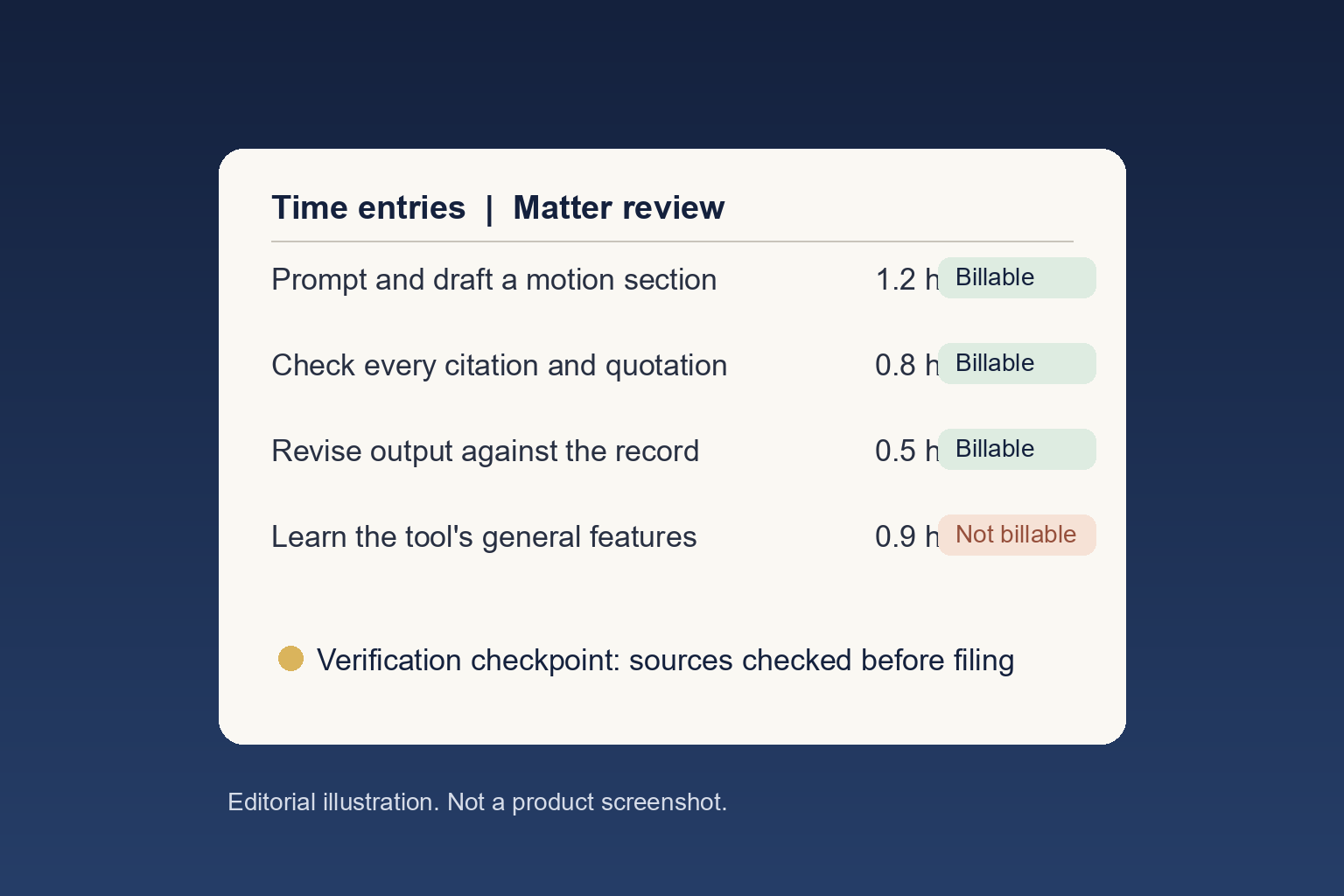
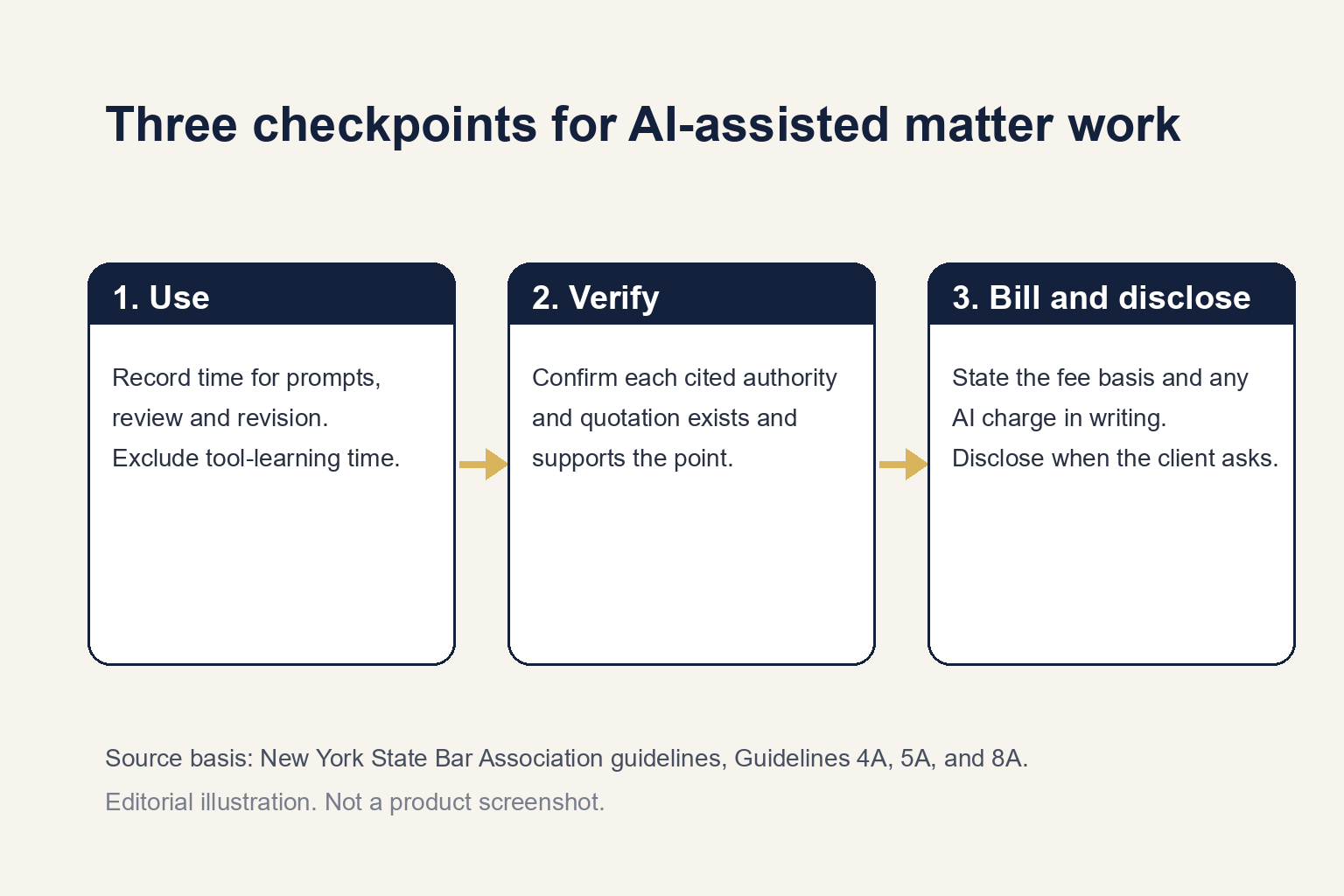
Guideline 5A is the core billing rule. A lawyer who bills by the hour may charge only for time actually spent. That time includes writing prompts and reviewing, verifying, and revising the output. A lawyer may not bill for the time the work would have taken without an AI tool. A lawyer also may not bill for the value of the output instead of the time spent.
Two further limits apply. A lawyer may not bill a client for time spent learning a tool in general. A lawyer may bill for time spent adapting or applying a tool to the particular matter, if that time is reasonable under the fee rule.
The general cost of acquiring and maintaining AI tools is ordinarily overhead. It may not be billed to a client as a disbursement. The exception covers charges for services or expenses tied to the client's matter, when the basis is disclosed and the amount is reasonable.
Non-hourly fees stay subject to the reasonableness rule. The report says that efficiency gains from AI do not, on their own, require a fee reduction. Whether a fee is excessive turns on the same factors that apply with or without AI.
Hypothetical example, not a real matter: a litigator spends 40 minutes checking an AI-drafted section against the cited cases and the record. Under Guideline 5A, that verification time can be billed if it is reasonable. The same litigator's first hour learning the tool cannot.
Client disclosure: when it is required
Disclosure is not required for every AI use. Guideline 4A sets four triggers. Disclosure is required when the client asks whether or how AI is used. It is required when AI output is a significant basis for advice on a decision reserved to the client, such as whether to settle. It is required when the use needs the client's informed consent under the confidentiality rule. And it is required when the use affects the basis or rate of the fee, or the expenses the client pays.
Outside those triggers, a lawyer may disclose AI use but need not. Routine administrative work, such as word processing, spell checking, calendaring, and timekeeping, needs no disclosure. Any client instruction, engagement term, protective order, or court rule still controls.
Fee disclosure follows a separate rule. The lawyer must communicate the basis or rate of the fee and the expenses, including any AI-related charges. That communication happens before the representation starts or within a reasonable time after. Put it in writing where the rules require, including under 22 NYCRR Part 1215.
*Editorial illustration. Not a product screenshot.*
Confidentiality and data flows
Guideline 6A asks lawyers to understand the material risks before entering protected information into an AI tool. The report lists safeguards to consider. They include access controls, encryption, retention and deletion controls, limits on training and secondary use, separation between clients and matters, subprocessor controls, incident-response commitments, and audit logs.
Guideline 6B extends the duty beyond what a lawyer types. If a tool sends client information to an outside service, keeps it, trains on it, or can reach across matters, the lawyer must understand and control those data flows before use. The report applies the nonlawyer-supervision standard to such tools by analogy.
The report also says that using an AI tool does not, by itself, create a conflict of interest. Conflicts can still arise under the general conflict rules, so the review must continue.
Court filings
Guideline 8A says that a lawyer must make the required inquiry before filing a paper, including a paper prepared with AI help. The lawyer must confirm that every cited authority and quotation exists and supports the point for which it is cited.
The report does not itself create a general AI disclosure duty for court filings. It says that whether a court requires disclosure or certification of AI use is governed by 22 NYCRR Part 161 and by each court's rules. This article did not review Part 161 or each court's rules. Check them before filing in a particular court.
What New York firms should change now
Use this short checklist to convert the guidelines into firm practice:
- Create a timekeeping entry for AI-assisted prompting, review, verification, and revision. Do not allow billing for general tool training.
- Separate AI tool costs that are overhead from any charge tied to a specific matter. Disclose the basis for each matter-specific charge in writing.
- Update engagement letters with the fee basis and any AI-related charges.
- Record where prompts, outputs, logs, and recordings go for each tool, including retention, training, and subprocessor terms.
- Identify matters where AI output could drive advice on a decision the client reserves. Decide when and how the client hears about it.
- Before any filing, check every citation and quotation against the source. Check the rules of the court where the filing goes.
- Set a review date for the firm's policy, since the report recommends an annual review.
Limitations and what to monitor
- The guidelines explain existing New York duties. The report says it proposes no amendment to the Rules of Professional Conduct or their Comments. The report does not say whether a court or disciplinary authority will treat it as binding. Ask New York counsel if that question matters to your firm.
- Only Section 4 is the operative text. Commentary and summaries explain it. Read that section before any policy change.
- Watch for Executive Committee updates and their ratification by the House of Delegates, as the report describes.
- Watch for changes to 22 NYCRR Part 161 and to individual court rules on AI disclosure.
Frequently asked questions
Does the New York report bind lawyers in other states?
The report applies New York rules. Lawyers in other states should check their own rules of professional conduct and any court orders that apply to them.
Does a firm have to tell every client that it uses AI?
No. Guideline 4A lists the cases where disclosure is required. Outside those cases, disclosure is optional, unless a client instruction, engagement term, court rule, or other law requires it.
Can a firm bill clients for an AI subscription?
Generally no. The report treats the general cost of AI tools as overhead. A charge may be made only if it relates to the client's matter, the basis is disclosed, and the amount is reasonable.
Can a lawyer bill for checking AI output?
Yes, for time actually spent reviewing, verifying, and revising the output, provided the time is reasonable. The report does not allow billing for time spent learning a tool in general.
Sources and scope
This article relies on the association's approved report, Version 7, and the association's announcement page. The report is the primary source. The announcement page supplied the approval context. Quotations and section numbers come from the report text. A secondary legal-news summary described billing and court filings in terms that matched the report, and this article does not depend on it.
The article does not cover the full New York Rules of Professional Conduct, 22 NYCRR Part 161, 22 NYCRR Part 1215, or any individual court's rules. Those sources control specific obligations, and a firm should review them directly.
Sources
Make every matter easier to manage
See how Hammer Lex connects matters, documents, time, billing, and client communication in one operational view.
Book a demo