
Pennsylvania Proposes an AI Certification for All Court Filings
A Pennsylvania Supreme Court committee published a draft AI certification for all court filings. It is not adopted. Comments are due November 24, 2026.
Quick answer
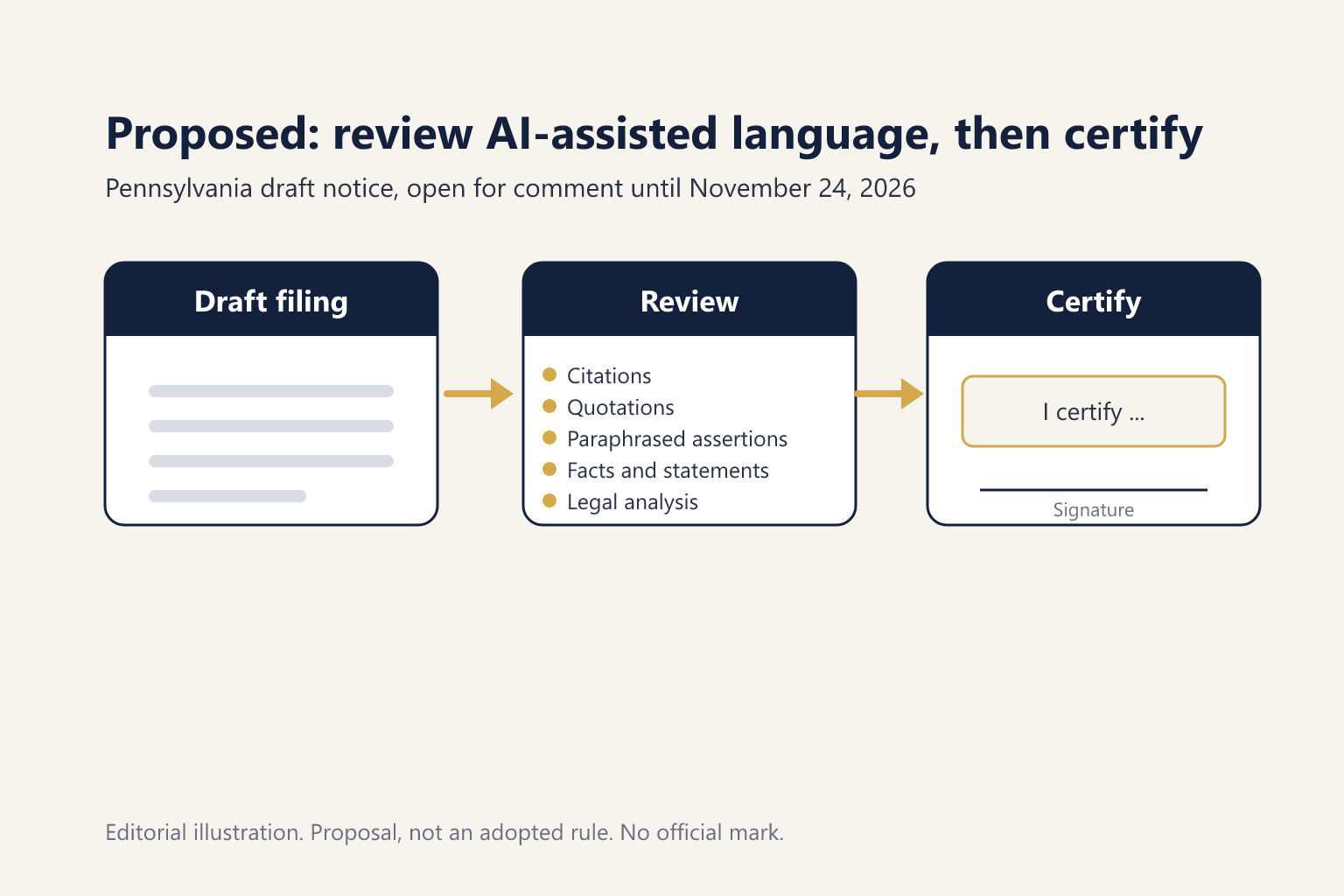
The Advisory Committee on Artificial Intelligence of the Supreme Court of Pennsylvania is considering proposing a statewide notice on generative AI to the Court. The draft would have filers certify, in every document submitted to a court, that they checked any language drafted with AI. It is open for comment, the Court has not adopted it, and comments should be received by November 24, 2026.
What the notice proposes
The notice appears in the Pennsylvania Bulletin at 56 Pa.B. 6888, Vol. 56 No. 43, dated Saturday, October 24, 2026. It was filed for public inspection on October 23, 2026.
The notice says the Advisory Committee on Artificial Intelligence (AIAC) is considering proposing the text to the Supreme Court of Pennsylvania. The Court has not adopted it.
The draft has two parts:
- A new "Notice Regarding the Use of Generative Artificial Intelligence by All Court Filers."
- An addition to the existing Certificate of Compliance. That certificate already carries the Case Records Public Access Policy certification. The notice marks the added text in bold and underline.
The draft does not propose an amendment to any Pa.R.C.P., Pa.R.A.P. or Pa.R.Crim.P. rule. It works through a notice and a certification form.
Three phrases set the scope. Filers would certify compliance "in all documents submitted to a court." The duty attaches to language "drafted by or with the assistance of generative artificial intelligence." The filer must "review and confirm the accuracy" of that language.
The list is broader than citations and quotations alone. The certification text reads "including but not limited to citations, paraphrased assertions, quotations, facts and statements, and legal analysis."
The certification may follow "substantially in the following form," or the filer may insert it in the filing itself. The explanatory report says the statewide protocol should "supplant" any local rules on the same topic.
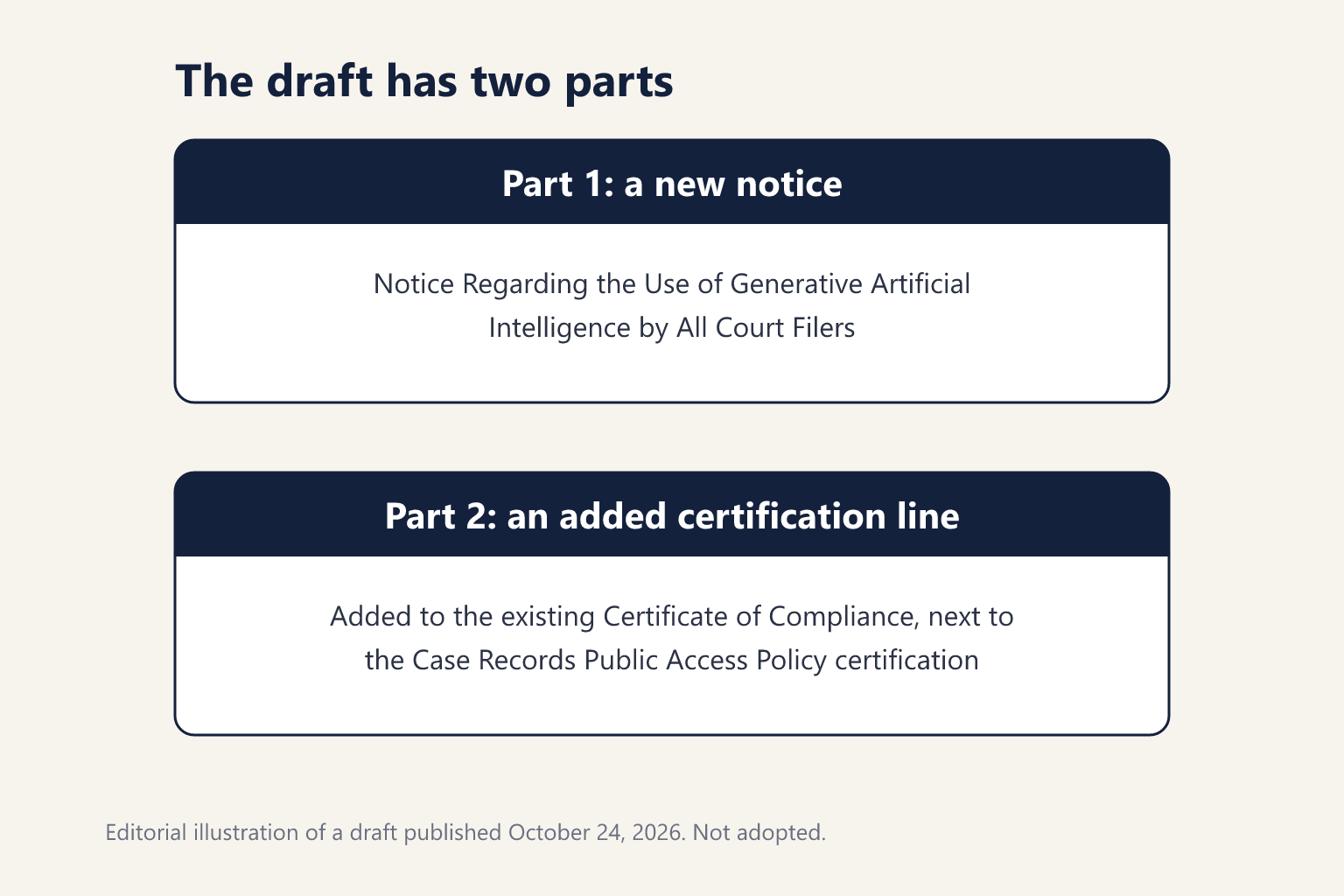
*Editorial illustration. Not a court form or a screenshot of the Bulletin.*
Why the scope matters for filing workflows
Editorial analysis. What follows is Hammer Lex's reading of the draft, kept apart from the notice's own text.
The draft keys the duty to the language itself. Which tool produced it, and what kind of document it sits in, makes no difference. A citation checker confirms that a case exists and that a quote matches. It does not tell you whether a paraphrased assertion is fair, whether a stated fact is right, or whether the legal analysis holds. Under the draft, all of those would sit inside the certification once an AI tool helped draft them.
That puts a new question in front of the person who signs. Which parts of this filing did AI help draft? Many firms cannot answer that today. Drafts pass from person to person and tool to tool, and nobody writes down where a paragraph came from. A firm that cannot trace that history has two choices. It can review every sentence as if AI touched it, or it can start recording AI use while the draft is written.
The phrase "all documents submitted to a court" matters too. On our reading, a short motion or a letter to the court would carry the certification as well as a brief. A review step built only for major briefs would miss most of what a firm files.
The existing Certificate of Compliance cuts both ways. Firms already complete the Public Access Policy certification, so the new line would ride on a step staff know. The risk is that a familiar form becomes a reflex. The signature should record that someone did the review.
If the statewide protocol does supplant local rules, firms that built a separate process for a local rule may be able to retire it. That depends on adoption and on the final text.
Hypothetical example, not a real firm: An associate uses an AI tool to tighten the facts section of a brief. The citations were added by hand and pass the firm's cite check. Under the draft's wording, the rewritten facts section is still language drafted with AI assistance. Someone has to confirm each of those facts before the certification is signed.
Practical checks before the deadline
Operational recommendations, not legal advice.
- Read the notice in the Bulletin. Do not work from a summary, since some summaries describe a narrower list than the draft.
- List where AI tools touch drafting in your firm: research, first drafts, editing, and summaries. Include AI features built into software staff already use.
- Decide how a draft will record which language AI helped write. A short note in the matter file at each handoff is enough to start.
- Widen the pre-filing review beyond citations. Use the draft's list: citations, paraphrased assertions, quotations, facts and statements, and legal analysis.
- Name the person who signs the certification for each filing, and write down what that person reviews first.
- Keep following any local AI rules that apply to your matters today. The Court has not adopted the statewide notice.
- Decide whether to comment. Comments should be received by November 24, 2026. Email is the preferred method: AIAC@pacourts.us. The postal address is Advisory Committee on Artificial Intelligence, Supreme Court of Pennsylvania, Pennsylvania Judicial Center, P.O. Box 61260, Harrisburg, PA 17106-1260. The fax number is 717-231-3327.
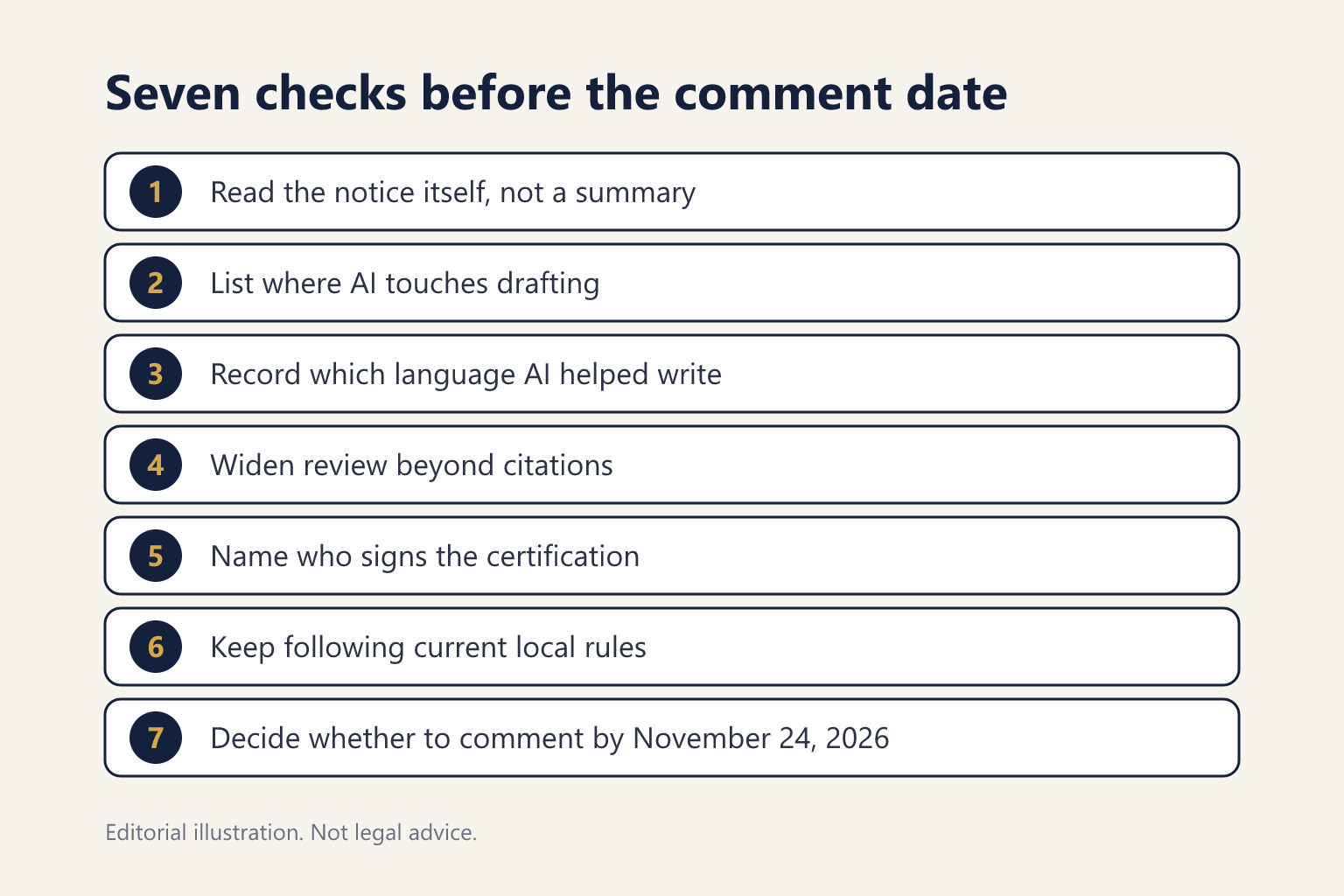
*Editorial illustration. Not a product screenshot.*
Limitations and what to monitor
- We read the online Pennsylvania Bulletin notice, not the printed PDF. Formatting such as the bold and underlined additions may differ between the two.
- This is a proposal. The AIAC may change it, may not propose it, and the Court may not adopt it.
- The AIAC page on pacourts.us describes the committee's 2025 Interim Policy for judges and court personnel. The Court adopted that policy on September 9, 2025, effective December 8, 2025. The page does not mention the October 2026 proposal, its comment deadline, or any adoption.
- The draft covers Pennsylvania courts only. We did not check other jurisdictions.
- Watch for a revised draft after the comment period, any order from the Supreme Court of Pennsylvania, and changes to local rules that the statewide protocol would replace.
Frequently asked questions
Does the certification matter if my firm used no AI on a filing?
The verification duty in the draft attaches to language drafted by or with the assistance of generative AI. The draft also has filers certify compliance in all documents submitted to a court. Our reading is that the certification line would appear on every filing, while the review it describes concerns AI-assisted language.
Does the 2025 Interim Policy already apply to lawyers?
No. The AIAC page describes the Interim Policy as covering judges and court personnel. The October 2026 draft is the one addressed to all court filers, and it is still a proposal.
Where should I watch for a final decision?
When we read the AIAC page on pacourts.us on November 21, 2026, it did not mention the October 2026 proposal. For now, we would watch the Pennsylvania Bulletin, where the draft first appeared, as well as the AIAC page.
Will a local AI rule still apply?
For now, follow the local rules in force. The explanatory report says a statewide protocol should supplant local rules on the same topic, but that only matters if the Court adopts it.
Sources and scope
The primary source is the Pennsylvania Bulletin notice at 56 Pa.B. 6888, Vol. 56 No. 43, published Saturday, October 24, 2026 and filed for public inspection on October 23, 2026. We read the notice and the issue index on November 21, 2026.
For context on the committee, we read the AIAC page on pacourts.us on November 21, 2026.
The search window covered developments from roughly November 11 to 21, 2026, plus the October 24 publication that sets the comment deadline. This article covers the Pennsylvania draft only.
Sources
Keep matter records in one place
See how Hammer Lex connects matters, documents, and time in one operational view.
Book a demo