
Research Inside AI Drafting Tools: Connector Checks
Harvey, Legora, and Microsoft connected legal sources to AI drafting tools in October 2026. Check accounts, citations, and permissions first.
Quick answer
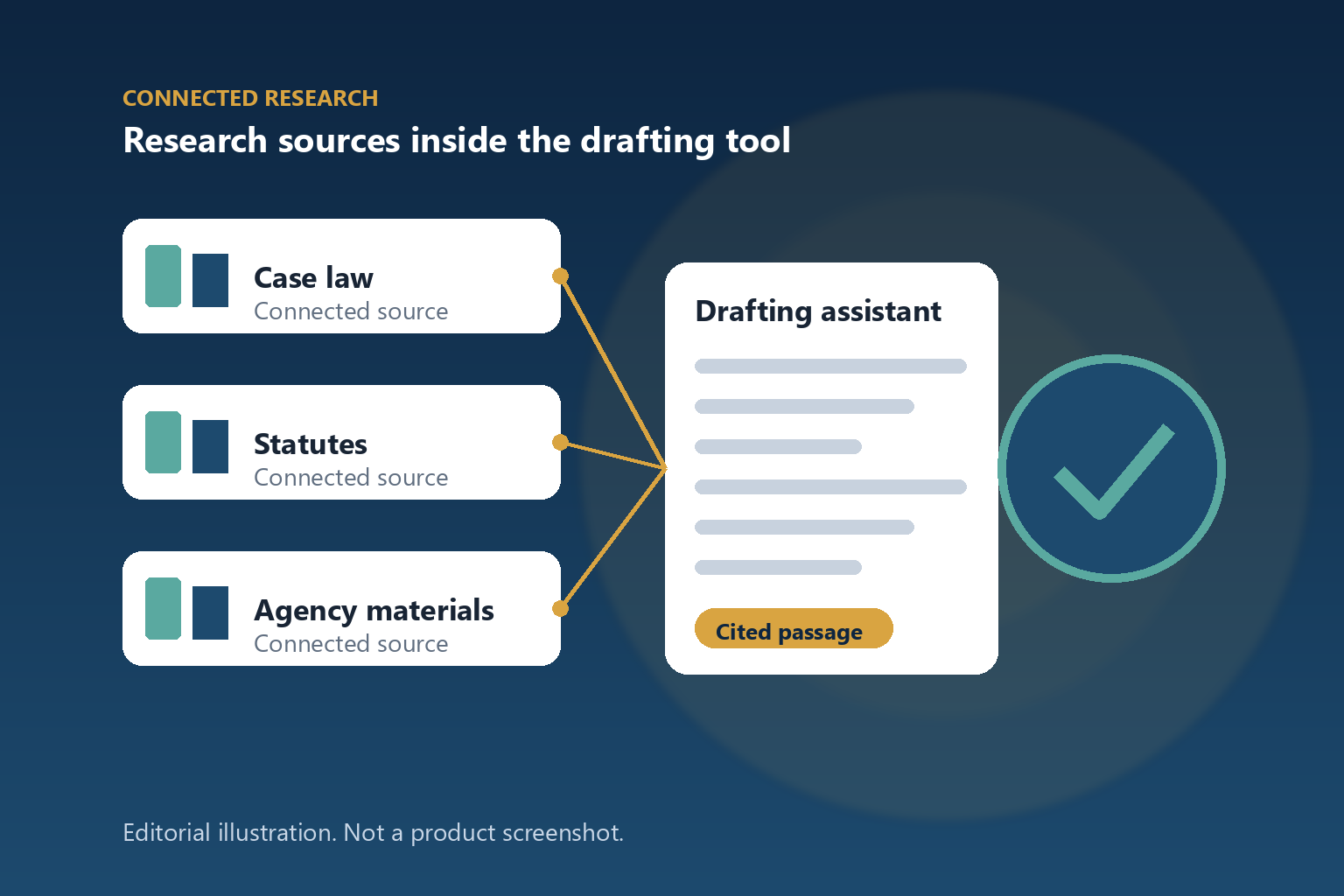
October 2026 brought three announcements that put research inside the drafting environment. Harvey announced a Midpage connector on October 19. Legora and Blue J announced a tax research integration the same day. Microsoft launched Copilot for Legal on October 15, with plugins that reach third-party legal sources.
For the firm, the research step now happens inside the drafting tool. Account rights, citation checks, admin settings, and data paths apply in both places. Confirm each one before a lawyer relies on a connected answer.
This article is informational and not legal advice. Duties on competence, confidentiality, supervision, and client communication vary by jurisdiction and by matter. Confirm the rules that apply to your firm before you change practice.
What happened
Harvey and Midpage (October 19). LawNext reported that Harvey users can run a Midpage search from inside a Harvey Assistant thread. The sources come back with citations in the final output. Midpage covers U.S. case law, statutes, regulations, and agency materials. The connector is limited to customers of both products. The announcement lists uses such as research memos, brief support, and checking that a cited authority exists and supports the point. Those are announced uses. None of them has been tested.
Midpage also lists a connector for Claude. That listing requires sign-in and names three tools: search, findInOpinion, and analyzeOpinion. It adds a warning: Anthropic does not control which tools a developer makes available, and cannot verify that a tool works as intended or keeps working.
Legora and Blue J (October 19). Blue J announced that eligible customers can put its tax research questions to Legora. The integration runs over the Model Context Protocol (MCP). Blue J does the research on its own infrastructure, and each answer carries inline citations to Blue J sources, subject to content permissions. Both products need a subscription, and each user signs in with their own account. Early access opens with selected joint customers. Blue J describes general availability as planned for November. Neither company disclosed pricing in the material reviewed. Legora told Artificial Lawyer the deal does not mean it is entering tax.
Microsoft Copilot for Legal (October 15). Microsoft's Message Center notice MC1509799 describes more than 20 legal skills in Word on desktop and in Cowork. The skills summarize, draft, review, and redline documents. They also check contracts against playbooks. The notice says the plugins "connect to supported third-party legal sources" but names none of them. Eligible users need Microsoft 365 Copilot commercial licenses. The Word legal plugin ships on by default; an admin can turn it off. The same notice says the Legal Agent is being retired. Worldwide general availability runs from mid-October to mid-December 2026.
What it means for law-firm workflows
Connected research moves three things: who runs the search, how the citation gets checked, and who holds the settings.
The account changes. A connected source may require its own subscription and sign-in. The firm needs to know which identity runs each search, because the research record hangs off it. A search run under a shared login cannot show which lawyer relied on the answer.
The citation check changes. A citation in a drafting tool is a pointer. It is not a verification. Blue J describes inline citations that link back to its sources. Harvey's announcement says the sources appear with citations in the final output. The lawyer still opens the authority, confirms the passage supports the point, checks that the authority is current, and confirms it applies in the jurisdiction. For the wider method, see AI Legal Research: A Verification-First Workflow.
The settings change. Admins decide which connectors and tool actions a workspace allows. Harvey's Connector Library page describes that admin configuration, plus a security review before any option is offered. Microsoft's notice describes an admin switch for the Word legal plugin. Find those settings before the first user turns a connector on.
The following scenario is hypothetical. A litigation associate asks a drafting assistant for authority on a discovery point. Back comes a case with a quoted passage. The associate pulls the full opinion and finds that the passage addresses a different procedural posture. The review step catches it before anyone drafts the brief.
Practical checks before a connector touches client work
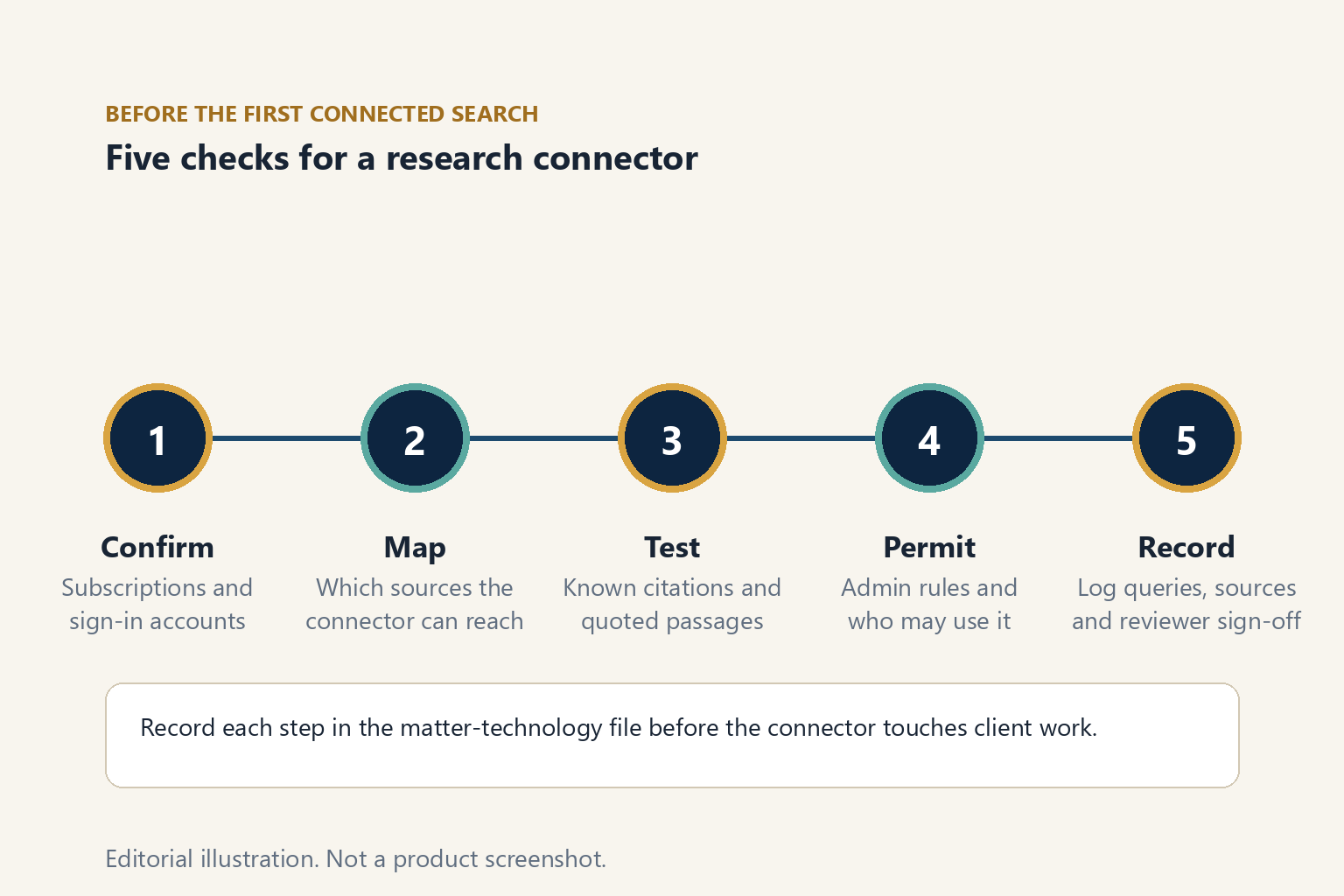
- Confirm subscriptions and accounts. Check that the firm holds each required subscription. Confirm that each user signs in with an account the firm can audit.
- Map the sources. List each source the connector reaches, with its jurisdiction and material types. U.S. case law, statutes, and agency materials are different scopes from tax research. Do not assume one source covers the other.
- Test with known authorities. Ask for authority you already know. Compare the quoted passage and the citation with the source. Record the result before the first live matter.
- Set permissions by role. Decide which practice groups and users may activate each connector. Confirm the admin settings for tool actions.
- Get written answers on data. Ask the vendor what query text leaves the firm, where processing occurs, how long logs are kept, and whether customer content trains models. The reviewed sources do not answer these questions.
- Ask about write access. Ask whether the connector can write data back to a matter system. The reviewed sources do not say.
- Keep a review rule. Every citation in a filing or client deliverable is checked by a lawyer against the source.
Limitations and what to monitor
- Early access and general availability dates may change. Blue J's November date is a plan, not a commitment for every customer.
- The Harvey Connector Library page in the copy reviewed does not list Midpage. The Harvey and Midpage details in this article come from LawNext's report of the announcement. I could not confirm the Harvey announcement itself.
- Microsoft's notice does not name the third-party legal sources its plugins connect to. This article does not rely on press reports that name them.
- The reviewed sources give no pricing, data-retention, or training terms for these connectors.
- Monitor vendor release notes, admin-center changes, and any new write access to matter records.
Frequently asked questions
Is a connected research answer a verified citation?
No. A connected answer shows where the source came from. The lawyer still reads the authority, checks its current status, and confirms that it supports the point.
Does each connected source need a separate subscription?
Each announcement describes needing an account or subscription for both products. Confirm the terms in your own vendor contracts before you rely on them.
Should a firm turn on every available connector?
No. Turn on the sources that match the practice areas using them. Keep permissions narrow until the known-authority tests pass.
What should the matter file record?
Record the source, the search date, the user, the citation checked, and the reviewing lawyer. Keep it under the firm's own retention policy.
Sources and scope
This article covers announcements and product notices dated October 15 to October 23, 2026. Research ran from October 13 to October 23, 2026.
- LawNext, "Harvey Now Connects to Legal Research Platform Midpage Through an MCP Connector" (October 19, 2026): lawnext.com
- Claude connector listing for Midpage (listing states it was added in February 2026): claude.com
- Harvey, Connector Library page (early access from mid-June; security review and admin configuration): harvey.ai
- Blue J, "Blue J Partners with Legora" (October 19, 2026): bluej.com
- Artificial Lawyer, "Legora Does Tax Data Deal With Blue J" (October 19, 2026): artificiallawyer.com
- Microsoft 365 Message Center notice MC1509799, "Microsoft 365 Copilot: Legal plugins in Word and Cowork" (October 15, 2026): mc.merill.net
Scope is limited to what these sources state. The article does not assess answer quality, accuracy rates, or jurisdiction coverage beyond them. The Midpage connector is described for U.S. materials. The Blue J integration is described for tax research. Check each product's current scope before you rely on it.
Sources
- https://www.lawnext.com/2026/10/harvey-now-connects-to-legal-research-platform-midpage-through-an-mcp-connector.html
- https://claude.com/connectors/midpage
- https://www.harvey.ai/blog/connector-library
- https://www.bluej.com/blog/blue-j-partners-with-legora
- https://www.artificiallawyer.com/2026/10/19/legora-does-tax-data-deal-with-blue-j/
- https://mc.merill.net/message/MC1509799
Keep research tied to the matter
See how Hammer Lex links research notes, documents, and time to each client matter.
Book a demo